I’m back on the river to settle a score. Almost three weeks have slowly passed since my last unsuccessful foray along the banks of the Rother. I have restocked my fly box, splurged on some new leaders and I’ve made sure that I have plenty of time on what is so far, proving to be a glorious evening. It is almost the middle of May now and I can’t help but feel like I am well overdue my first fish of the season. The settled weather we have been enjoying of late was interrupted by a brief interlude of stiff north easterly wind which brought with it some cooler temperatures. So, although I’ve been chomping at the bit to seek my redemption, I have exercised patience, waiting for the opportune moment. That moment has finally arrived. The prevailing summer breeze has veered around to the south west, accompanying it, the more clement conditions I’ve been holding out for. As I clamber over a wobbly galvanized gate, rod in hand, I am perhaps unwisely, feeling confident.
Still on the Cowdray Estate, I’ve headed further downstream to a beautiful stretch of straight, shallow and fast flowing water. The canal beat is the result of a bygone era of river navigation dating back to the late 18th century and although the last river traffic traversed these waters well over a century ago there still remains the now naturalised cuts like the one I will be fishing today.

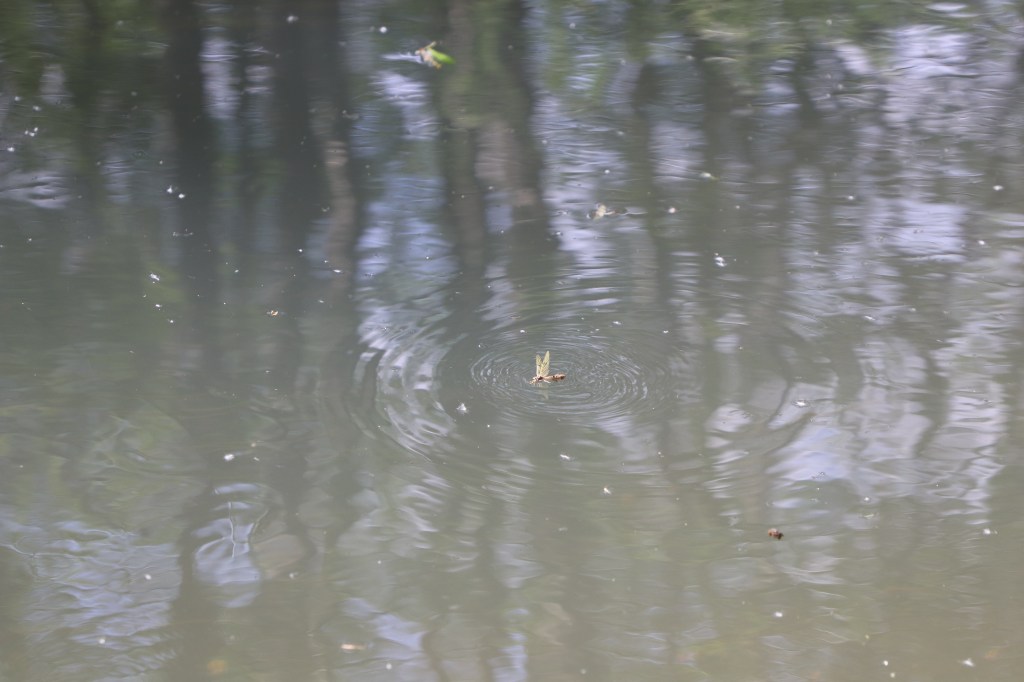
It is an enervating walk across the recently grazed meadow in the warm sun. A carpet of dandelion pappus covers the trampled grass resembling a dusting of melting snow. A pair of Egyptian geese, looking out of place in this temperate English setting, flap clumsily into the air and fly a short distance before landing heavily, tail feathers shaking, heads bobbing and honking loudly, irked at being disturbed. Crossing the now arid flood plain I come to a deep pool in a sharp bend of the river. As I poke my head over the high bank a family of mandarin ducks, more well established interlopers now comfortable in their adopted home, jump into the air with a splash. The drake’s intricately marked face, like painted porcelain, is visible in sharp detail as it flies past at eye level before climbing frantically through the dense branches of an overhanging alder. I’m not fishing this section of water so I don’t pay it much heed as I stroll by, but something catches my eye and I stop abruptly mid stride. There, fluttering lightly above the slow water, is that most hallowed of riverine insects, the mayfly. Not just a lone bug, but several, all dancing chaotically in the still air. Climbing high on transparent, veined wings then diving down, kissing the water’s surface and leaving delicate rings of ripples, before ascending once more.
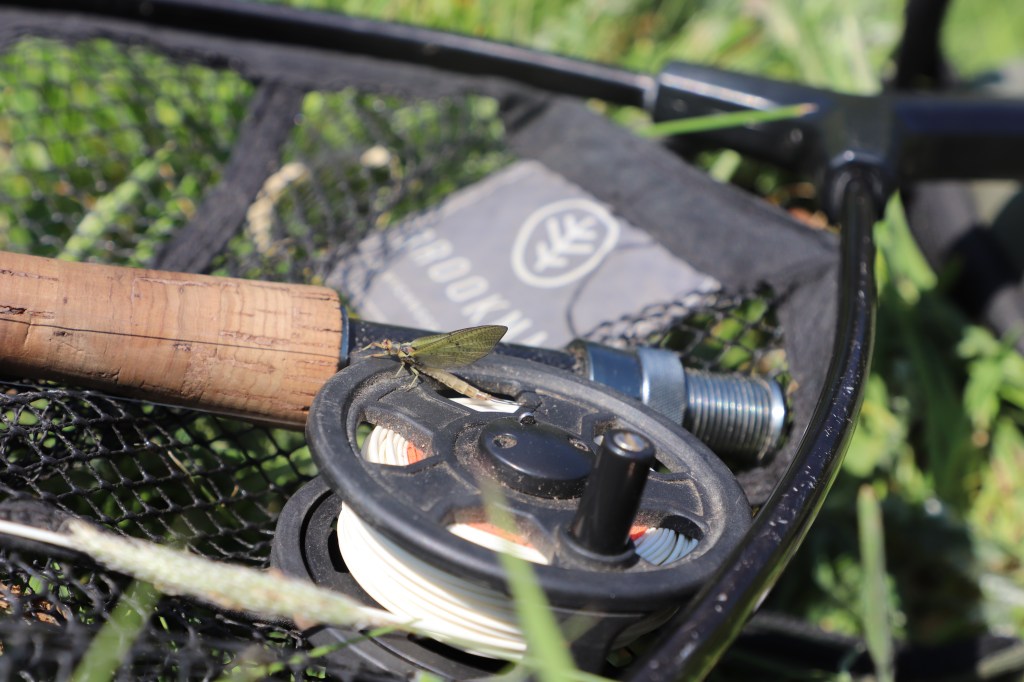
To the trout fisherman, the natural phenomenon of the mayfly hatch marks some of the most exciting dry fly fishing there is in Britain. Every year, like clock work and typically between May, as their name suggests, and June, these long bodied up wings emerge from their larval state below the cool surface of the river to complete their short-lived reproductive cycle before their curtain call. This period of time, known colloquially as “duffer’s fortnight”, sees the trout become reckless with insatiable hunger, gorging on this sudden abundance of food.
On rivers such as the Test many decades of recorded hatches mean it can be timed accurately to within a few days each year but here, on the Rother, we as yet have no such records so it is less easy to predict. I count myself lucky to be stumbling dumbly into it and take note of the date. Perhaps I will start the record today. Although I haven’t planned to fish this pool I sit for a few minutes and watch the surface. I don’t see any rises but I’m not too surprised that its quiet on this slow-moving section of water. I use this time to select a mayfly pattern from the fly box and quickly tie it on before picking up the pace to the canal stretch, my excitement brimming.
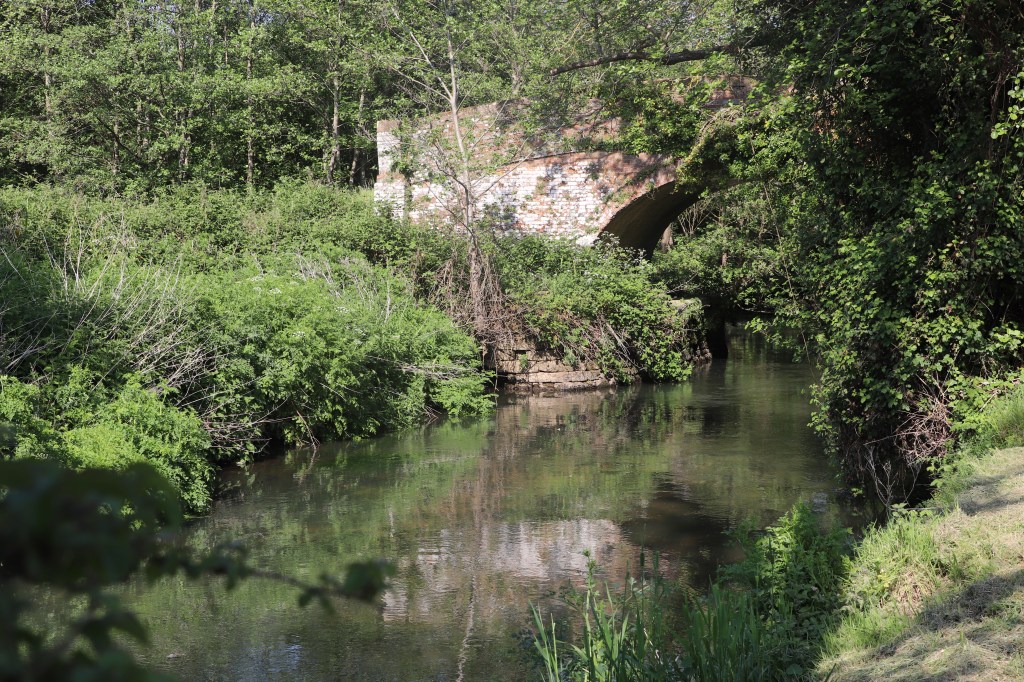
Across two narrow foot bridges, a small overgrown paddock and over a wooden style, I arrive at the shaded river’s edge. Bird song fills the air and the river babbles past under an arched stone bridge. I set my pack down and sit beside it in the long grass with my legs dangling over the water while I study the long stretch of water flowing away from me, grateful to be in the cool shade after the long walk. I’ve barely got comfortable when I see the first rise, then another and another. The river is alive with activity and I can’t help but smile to myself as I rise slowly back to my feet. The fish are here but now it is up to me to think tactically and plan my careful approach. I’m unable to get below the fish without the risk of spooking them from the narrow path that runs along the low banks so I’m forced into the woodland beyond.

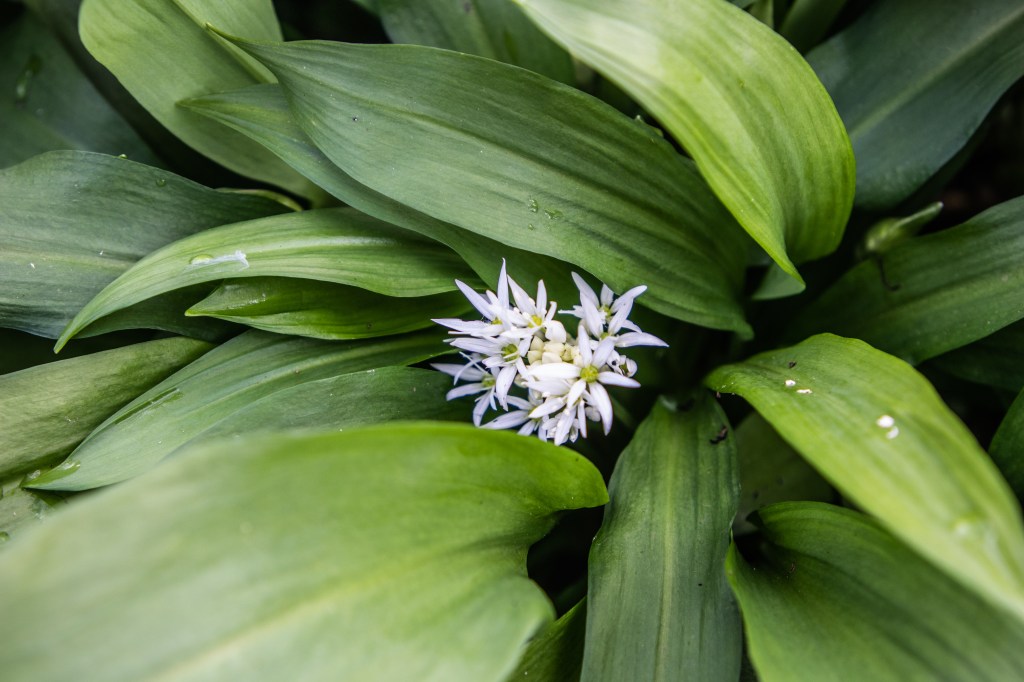
Crouching through the thick brush and weaving my rod through the tangled growth, I make my way slowly and circuitously downstream until I’m far enough below the rising fish to slip back out of the cover. Crawling clumsily out of the dense undergrowth my nose is filled with the savoury scent of wild garlic. The banks here are covered with the juicy leaves and white blossoms of this forager’s favourite and I make a mental note to grab a few handfuls before I leave. I’m relieved to find that my new position on the bank offers ample space for casting between two mighty oaks. Their gnarled roots clutch at the banks and the sprawling canopies offer protection from the bright sun now sinking low in the cloudless western sky. As I brush leaves and twigs off my clothes and out of my hair, I watch a hapless bug fly too close and too clumsily to the flowing water. Trapped by surface tension, fluttering desperately to break free, it seals its own fate and is soon slurped lazily below the surface by a hungry trout.
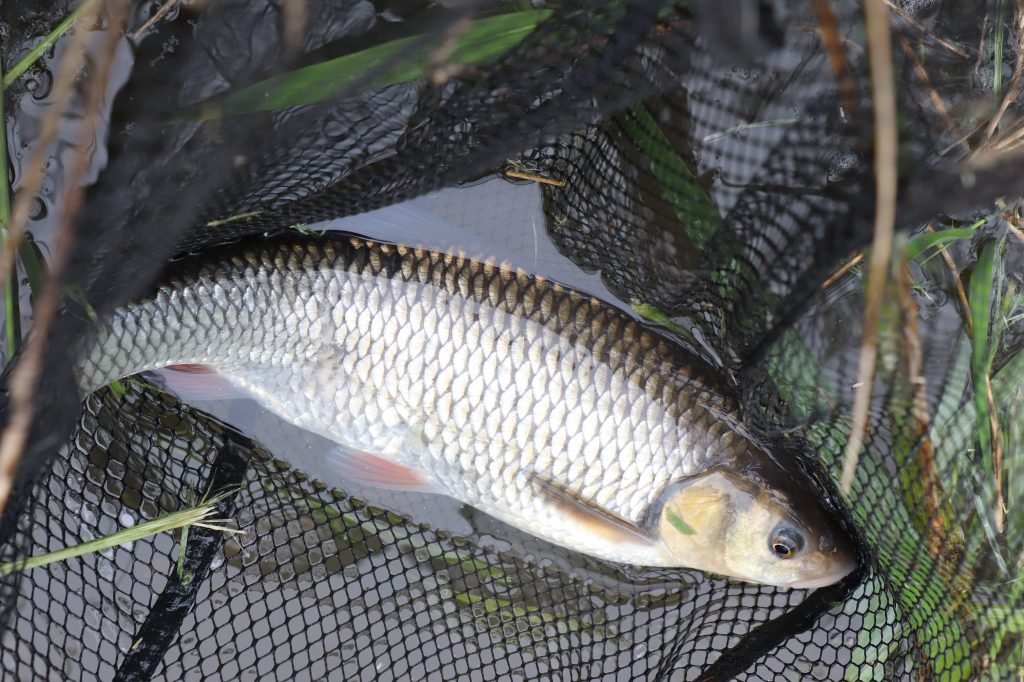
On bended knees I quickly strip line off my reel and make a false cast to judge distance before hauling the fly back and powering it forward, releasing the line and letting the neatly tied feathers settle lightly on the river. Fleeting seconds pass, I’ve barely had time to check the line is free and clear at the reel before the fly disappears, snatched below the surface. The line comes tight as I lift the rod tip and the fish runs, first side to side and then straight down stream just below me. This is no trout! As the line scythes through the clear water at my feet I see to my surprise the fat, golden scaled form of a chub racing to free itself from its unknown assailant. Line burns through my fingers and up through the eyes of the rod before I manage to slow its pace as the fish enters a deep pool under the low branches of the oak. The blistering run is now reduced to wild head shakes and I can’t help but worry that all this commotion will have spooked the trout that this chub beat to the fly. My concern is soon proven unfounded when I see, out of the corner of my eye, two fish rise almost in unison.
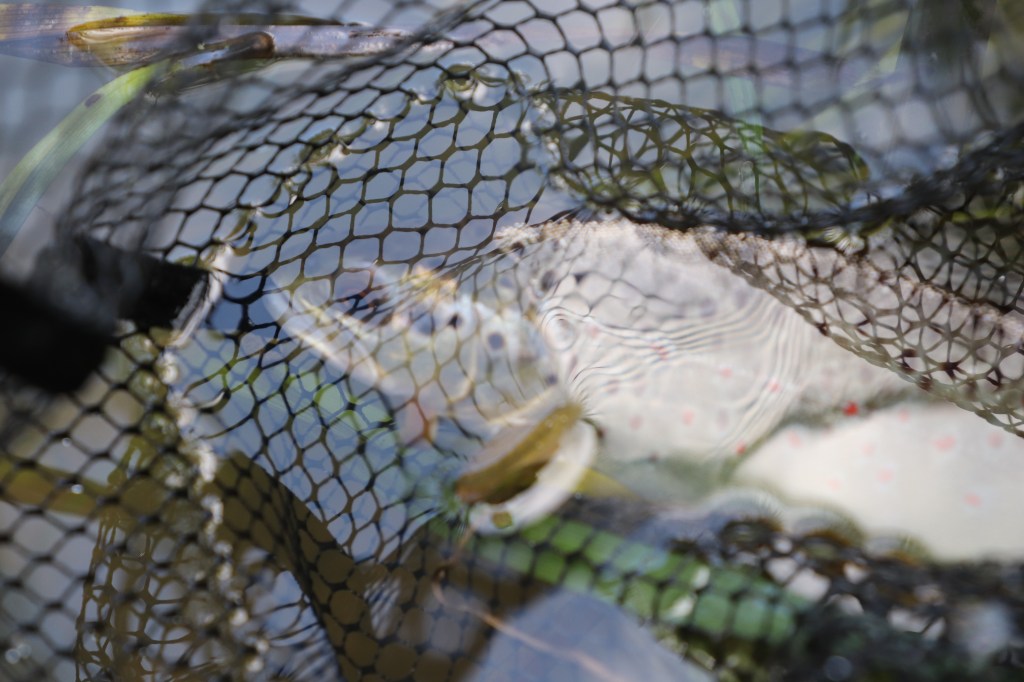
The portly chub soon realises that resistance is futile and I muscle the girthy fish into the bank in short order, eager to get it out of the way and get my fly back over the feeding trout. Red fins and shimmering scales weigh heavy in the net as I haul it up to unhook the spritely lump. Although this wasn’t my target species it is a good fish, pushing four pounds and in great condition. After a few moments of recovery in the submerged mesh, it tastes freedom and swims off sulkily down river while I get reorganised. My fly is wet but still presentable and the leader unscathed so, blowing the damp feathers dry, I hold fire until I see another rise. I don’t have to wait long and soon my fly is sailing through the air, probing upstream before being delivered once again to the calm surface of the water. The ripples as it lands have barely dissipated when, for a second time the fly is engulfed by a hungry fish. I don’t have to wonder at the culprit on this occasion as the eager trout gets airborne in its effort to secure what it thinks is another easy meal. This is what I have been waiting for! I can see in the fraction of a second that the fish is out of the water that it is a nice sized wild fish by Rother standards. Lifting the rod firmly I set the hook and the surprised fish once again leaps from the water, shaking bodily to try and rid itself of the fly. The barbless hook holds fast under the pressure from the tight line. With baited breath and an elevated heart rate, I start to gingerly ease the fish in, letting it run when it wants to and regaining line with every chance I get. Forcing myself not to rush.
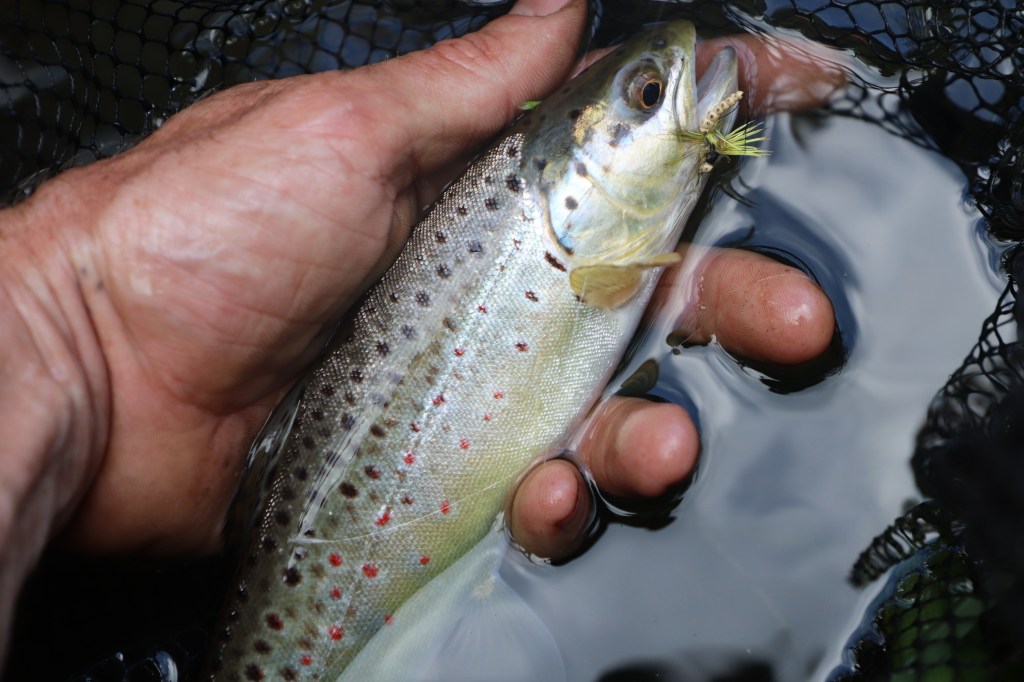
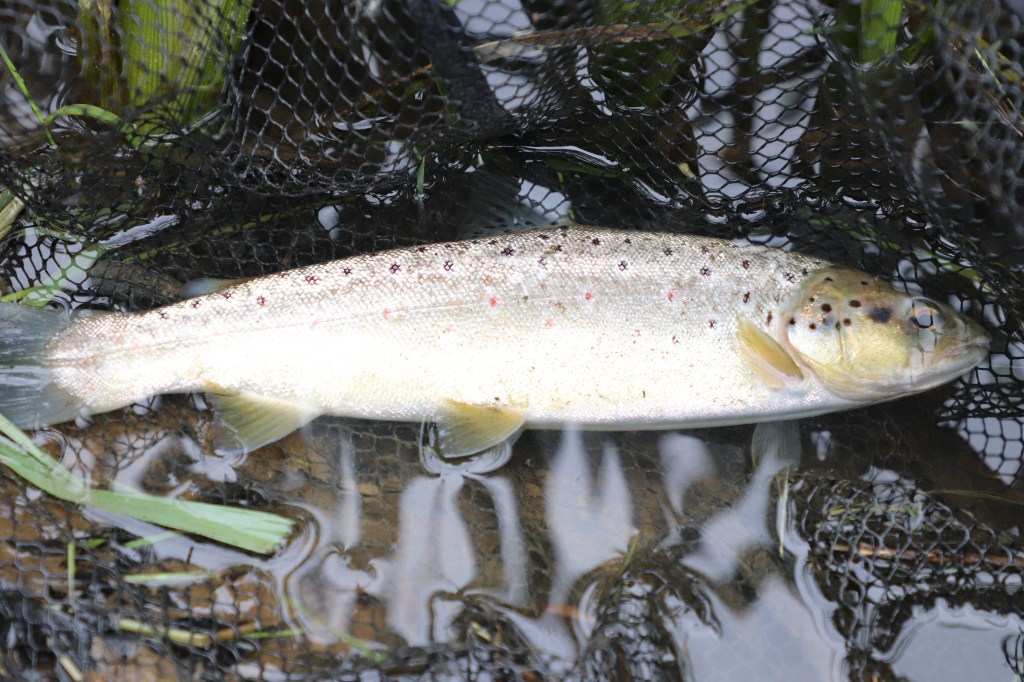
As the slender bar of gold and silver nears the bank I lower my net, holding the rod up high to shorten the distance. The strange billowing mesh lurking in the reeds spooks the fish and with renewed vigour it makes two last desperate runs, forcing me to reposition and angle the rod to reign it in, directing it back toward me. Eventually after a valiant effort the fish tires and I am able to slide its microscopically scaled body across the surface and into the net. Confident that it’s secured I place the rod on the bank and lay down to examine this jewel of the river. Every time I catch wild brown trout I am struck with awe at their beauty. Perfectly mottled to blend into their aquatic environment and intricately marked as if hand painted, each one unique. Splashes of black dots punctuated by vivid red circles adorn its flanks. The dark metallic shimmer on their backs lightening subtly down to a buttery yellow belly and delicate translucent fins boldly outlined in white. I leave it in the net while I admire and appreciate this perfectly evolved wonder before gently removing the fly from the corner of its mouth and letting it rest and regain its strength in the revitalizing flow of moving water. Long moments pass before rapid, energetic flicks of the tail tell me its ready to go. I dip the net and with careful hands direct it to freedom. With a flash its gone, melting quickly back into the gravel bottom below.
I am elated and stand smiling smugly at my success. I could pack up now and make the long walk back to the truck. I have finally opened the account for this season and it is with great relief that I have discovered that I’ve still got it. The pressure is off but I am keen to add to the tally. The fish are still feeding eagerly and I have plenty of time. It would be rude not to stay a while. I check my drenched fly and decide its time to change. The tiny sharp teeth of the trout have stripped the feathery wings and twisted the delicate body. Fortunately I have no shortage of mayfly patterns in the box after over zealous purchasing in seasons past.
I don’t have to move far before another two fish are brought to the net. They are not wild but that does not detract from the excitement of getting them to the bank. Although they are not born and raised on this wild stretch of river they are just as hard fighting and, in my opinion, as close to their native cousins as it is possible to get in a farmed fish. Hatched and raised at the picturesque Duncton Mill trout fishery, less than ten miles away, they have spent their lives growing in beautifully clean and clear, chalk filtered water bubbling up from natural springs at the base of the South Downs. The result of these perfect conditions and of course talented husbandry, is a fish that is often hard to tell apart from our resident fish.
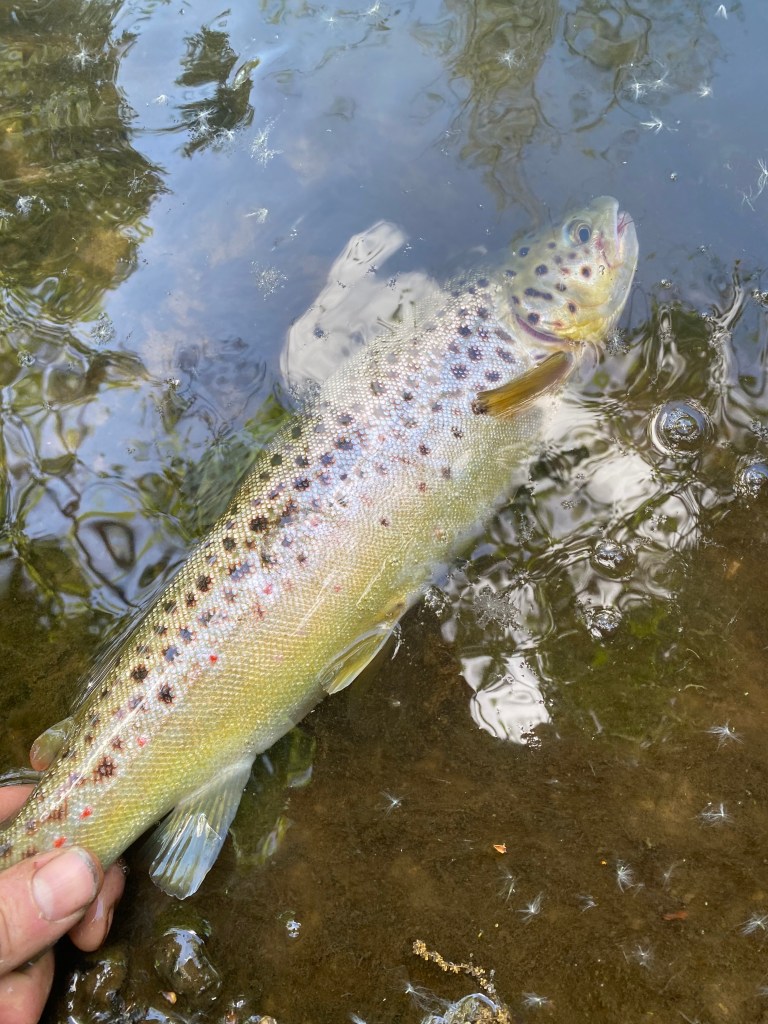
As the last stunning trout slips through my fingers and back into the safety of the river, I take stock of the evenings efforts and take a moment to appreciate how fortunate I am. Not only because I have finally caught the fish I’ve been yearning for but also because in an ever changing and chaotic world I am lucky to be able to escape for these brief moments and surround myself in the comfort and beauty of nature that, to me, is so nourishing and cathartic. I use the rest of my time on the peaceful banks to sit and watch fish rise untroubled as the dappled light, filtering down through the leafy branches, moves across the water. Evenings such as this are hard to beat and this one has certainly been worth the wait after my first unsuccessful outing.
My moment of repose is interrupted by the unmistakable monosyllabic and sharp whistle of a king fisher heading quickly upstream. I sit still and cast my eye down river. In a flash of electric blue and orange feathers the little bird races past, low above the water. He has no time to stop on his last rounds of the day, only calling at likely pools where he will sit motionless on overhanging branches, peering into the silty depths for any hapless minnow to ambush from above. I wish him luck and hope he has sequestered safely, deep in a steep bank, hungry mouths to feed. Somewhere in the distance, joining the summer chorus, a cock pheasant crows raspily, beating the heavy air with his wings. Cows low and a tractor rumbles monotonously over manicured polo lawns.
The season of this high stakes equestrian sport is upon us here in Midhurst and the sprawling pitches require daily cutting, watering and rolling to keep up with the herds of pounding hooves that stampede across them throughout the summer months. The usually quiet, winding country roads will soon become clogged with patrons, horse lorries and spectators as they descend upon this sleepy market town, toing and froing between matches in fizz fuelled reverie. This is of no concern to me now though, as I sit contently, enjoying these moments of solitude and serenity, happily observing the quiet happenings of life on the ever flowing river.
 The Wayward Sun Blog